Five Questions with Professor Xi Song
(January 2026)
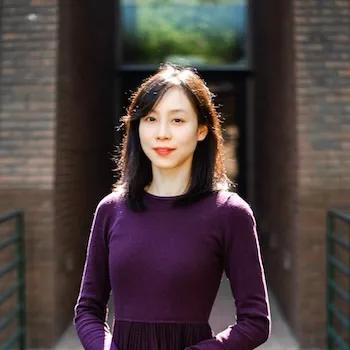
For this edition of our Five Questions Q&A Series, we're happy to feature the department's newest faculty member: Professor of Sociology and faculty member of the Asian American Initiative Xi Song. Xi is a quantitative sociologist who studies social mobility, occupations and work, and Asian Americans. Before joining Columbia, she was the Schiffman Family Presidential Professor of Sociology and a faculty member of the Graduate Group in Demography at the University of Pennsylvania. We're thrilled to have her here at CU!
To learn more about Xi, read her answers to our questions below!
1. What research projects are you currently working on?
I’m currently working on two main projects. The first examines occupational restructuring in the United States and what it implies for the future of work. It focuses on how AI-accelerated changes in the occupational structure, along with population aging and economic cycles, are reshaping career progression through shifts in jobs, occupations, employers and organizations, and earnings. My other project investigates Asian Americans and the historical origins of the “Model Minority” narrative. It traces changes in educational attainment, labor market outcomes, and intergenerational mobility from the Asian Exclusion era (1882-1942) to the present. The findings highlight areas where Asian Americans have reached parity with White Americans, as well as domains where a “bamboo ceiling” persists despite Asians’ high levels of education, experience, and performance.
2. What is one piece of research/writing that has really inspired you (either recently or while you were a student)? How has it influenced your sociological imagination?
Robert Mare’s 2010 PAA presidential address, A Multigenerational View of Inequality, has been deeply influential for me. It argues that most research on mobility focuses too narrowly on a two-generation (parent-to-child) framework and therefore misses important sources of persistence that operate through grandparents, other ancestors, and wider kin networks. Mare also emphasizes that multigenerational inequality is reinforced both by institutions that outlast individuals and by demographic processes, such as fertility, survival, migration, and marriage, through which families shape the opportunities of later generations. This perspective helped shape how I think about inequality as something reproduced across multiple generations through intertwined social and demographic mechanisms, not just through parent-child transmission. I was fascinated by the ideas and decided to pursue a PhD degree at UCLA and worked on this topic for my dissertation. I actually started to work on my dissertation during the summer before I formally started graduate school.
3. If you weren't a sociologist, what would be your career?
When I was in middle school, my dream was to become a sports journalist. Back then, I thought it was the coolest job. In hindsight, that’s probably not so different from today’s high schoolers aspiring to be social media influencers. But my recent research on occupational restructuring shows that journalism has contracted substantially as a profession, so I’m very happy to be a sociologist. At least by the Bureau of Labor Statistics’ projections, our jobs look relatively stable over the next decade.
4. What is a song (or artist, album, movie, book, TV show) that you've been into recently? Why should we listen to it (or read/watch it)?
When I am not reading academic stuff, I am really into books about health, fitness, and nutrition. I have recently read David Sinclair’s Lifespan (he is actually working on a second edition now) along with Michael Greger’s How Not to Die and Peter Attia’s Outlive. They all synthesize the latest scientific research on aging and give really practical advice on living healthier and longer.
I have also been listening to the audiobook of The Almanack of Naval Ravikant, which captures his thinking on building wealth and finding long-term happiness. What I find especially inspiring is his personal journey: he immigrated from India, grew up in Queens in a lower middle-class family, went to Stuyvesant, and eventually became this prominent Silicon Valley figure and public intellectual.
Lately, I have been thinking a lot about educational philosophy and reform in the AI era, especially the differences in educational elite recruitment between China and the U.S. Two books really shaped my thinking here. The first is Peter Hessler’s Other Rivers: A Chinese Education, which is about how he and his wife enrolled their two daughters as the only foreign students in a local Chinese elementary school -- actually close to my hometown. Drawing on that experience and his earlier time teaching in China back in 1996, he gives this really vivid picture of how dramatically education has transformed there. Hessler and his wife Leslie Chang are both journalists and I am a big fan of their work. I actually read all of their books. The second is The Highest Exam by economists Hongbin Li (Stanford) and Ruixue Jia (UCSD). They combine data with personal stories to explore how China's college entrance exam (the Gaokao) shapes opportunity and social mobility, with some useful comparisons to the American system.
5. Now that you've been in New York City for a semester, what have you been enjoying here (foods, activities, etc.) that you can't do or don't have easy access to in Philadelphia?
I am glad that you asked this. NYC has definitely changed my daily routine. I’ve become one of those people who walks everywhere, like, aggressively, I’m hitting 15,000 steps a day without even trying. I actually gave up my gym membership, though I might rejoin at some point, mostly for Pilates classes (NYC apparently has the most amazing teachers). For now, my workout plan is: walk fast, dodge tourists, and pretend I’m late to something important.
Thanks, Xi! Welcome to the department!