In Memoriam: Harrison White, 1930 - 2024
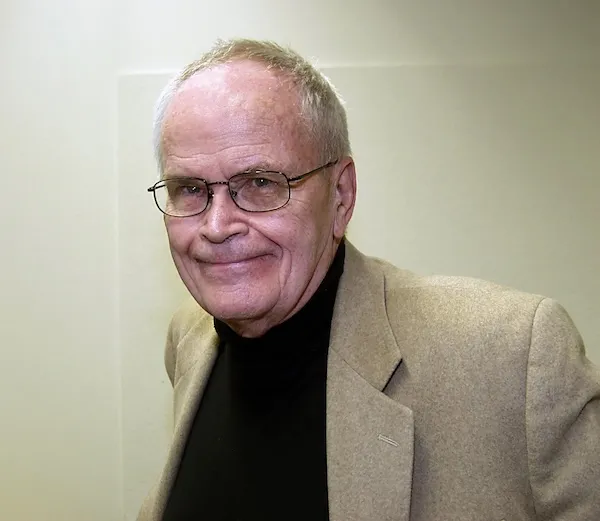
Harrison Colyar White passed away on May 19th, 2024 at the age of 94 in Tucson, Arizona.
Harrison joined Columbia University in 1988 as a professor of sociology and the director of the Paul. F. Lazarsfeld Center for the Social Sciences (now ISERP). He was named the Giddings Professor of Sociology in 1992, and served as the chair of the Department of Sociology for a number of years until his retirement.
Harrison played a key role in defining Columbia’s brand of sociology during his tenure at the university, but his impact on the discipline goes far beyond the confines of a particular time or place. He made contributions to a panoramic range of subfields and research areas, including kinship studies, social mobility, organization theory, artistic creativity & production, economic sociology, and studies of human language. Harrison was at the vanguard of the “Harvard Revolution” in social networks research while he was a professor in Cambridge. Equally groundbreaking and inscrutable, he defined a number of concepts and mathematical models of social structure that had a significant influence on the discipline, including structural equivalence, vacancy chains, and blockmodels. These concepts and models promoted an innovative understanding of social structure as patterns of relations rather than as attributes and attitudes of individuals. This relational view of the social world laid the foundation for what would become known as the “New York School” of relational sociology, encompassing the work of cultural sociologists and social networks researchers across Columbia, NYU, and The New School for Social Research.
As Kieran Healy noted in a blog post in 2008, perhaps the greatest testament to Harrison’s influence is the quality and quantity of research that his students and colleagues have produced. What was evident in 2008 is even more clear in 2024. An astonishing number of researchers in Harrison’s orbit were, would become, and/or remain, some of the most important figures in social science, let alone sociology.
A number of these students and colleagues have kindly shared their remembrances of Harrison. You can find their words below.
Some years ago, Paul DiMaggio invented the Theorodology Prize and Harrison was the first awardee. That was such a good idea. Methodology is the primitive set of tools we use to constrain ourselves in the creation of new objects. Without methodology it would be too easy to build new things. Theory is the art of learning how free oneself from the harassing presence of the real world that – like an insistent guest – keeps returning and threatens to never leave. Harrison demonstrated that simultaneously advancing and intwining both method and theory enables real discovery. Harrison discovered more things than anyone I know. A small list includes, short chains, vacancy chains, structural equivalence, production markets, image matrices, and so on using simple algebras, one-way mirrors, tricks from operations research, and simple sleight of hand.
For Harrison, doing sociology was a normative project. He wanted to identify the tangible sources of constraint so that we could embrace and experience real freedom. He believed that structures are out there waiting to be discovered and that it is our job to reveal them. I was lucky enough to be his student and found in this one simple idea enough to motivate a lifetime of work, a gift for which I am deeply grateful.
Harrison, true to his theory of action, knew how to develop his collaborators -- using an uncommon mix of positive pressure and compassion. He knew how to inspire and demand, but also when to encourage and support. Most of all, he graciously taught us better ways to think about the world.
As a graduate student at Columbia, I was fortunate enough to contribute to two chapters in Harrison’s 2008 revision of Identity and Control, co-author an article with him for Theory, Culture & Society, and have him serve on my dissertation committee. These projects offered a deep immersion in both his grand worldview and the Whitean style of prose, which could be very difficult to digest for even his most enthusiastic followers. Harrison’s years of research and teaching offer us in the sociological discipline a vivid framework for viewing and examining people and places, one which I carry with me to this day.
Harrison’s classes constituted one of the most intellectually enriching experiences of my life. As assignments, he would ask us to write memos on topics ranging from neuroscience to power. We knew that we had done a decent job if he said that our work was “trenchant.” Learning from Harrison also led to lively and unexpected moments. During one course meeting, he asked all of his students to go around the room and describe our romantic entanglements: spouses, girlfriends, boyfriends, casual dates, etc. Totally uncomfortable at first, we gradually divulged our various statuses while Harrison listened attentively, asking probing questions but offering no judgements. The unexpected roundtable discussion about what he called our “liaisons” actually served as a bonding experience, a respite from the stuffy tenor of campus seminars. In creating this context, Harrison helped us to connect as people and not just colleagues.
Harrison C. White, a founding giant of the relational turn in American sociology, has left us a monumental theoretical model that explains how social formations emerge. The model begins analytically with identities triggered by stochastic processes at any scale, from individuals to empires. Once decoupled from their environments, identities seek footings vis-à-vis other identities in control efforts to reduce uncertainty and self-organize in disciplined molecules that secure perduration. Signaling and comparability among identities are key. Specialization ensues. Increased complexity triggers further control efforts and so identities polymerize ever more intricate social networks and domains (netdoms) that merge in social ties delivering reflective stories and temporalities. Identities switch across these netdoms seeking further footing and changing contexts that spark new meanings. The entire process is scale-free and recursive.
In the 1990s Harrison White recognized the mounting limitations of formal network analysis in capturing identities’ phenomenological switches across complex netdoms and temporalities. So to further understand social emergence, he turned to the constitutive capacities of language, more specifically Peircean metapragmatics and linguistic indexicality, to theorize context-making and meaning production in social life. It was in the context of these intellectual frontiers that I had the honor and privilege to cross paths with Harrison as graduate student at Columbia University. We connected intellectually and after I graduated and became a sociology professor, collaborated on a series of important publications diving deeper into these analytical matters. To state that my sociological perspective was profoundly shaped by his vast knowledge is an understatement.
Moreover, beyond Harrison’s undisputed stature as a social scientist, I would like to share that he was also a remarkable teacher with impactful pedagogical moments. I will always remember that day in his graduate seminar on language. At some point, he intentionally “breached” us all by suddenly staying still, staring into space in silence for a few minutes. We, the seminar students, were caught by surprise and began experiencing anomie, at first nervously looking at each other, giggling, and increasingly losing footing of the situation. When the breakdown of the social order became unbearable, Harrison resumed interaction and explained that he had conducted the breaching experiment to show how social reality is fragile and actually an active co-construction that requires considerable phenomenological effort by all participating actors.
Harrison will be missed but his extraordinary intellectual legacy lives on through all of us, many generations of disciples. In my view, it is because of Harrison White’s genius and monumental ideas that we can still in the 21st century believe in the project of Sociology.
At one point in Don Quixote, someone describes the knight as "mad in patches but full of lucid intervals." I first encountered Harrison in 1991 or 1992, when he'd just published Identity and Control. That was, I assume, the product of one long mad patch, and his students spent too much time trying to decipher it. My time with him was trying for us both, partly because of my difficulty in committing to a dissertation topic, the result of an aversion to specialization that Harrison couldn't do much to remedy given his own intellectual restlessness. I exasperated him at times. Once we took a road trip to Cornell, partly so that I could get some feedback on my dissertation research. As I was presenting some results, and receiving suggestions, Harrison became angry that I was not modifying my talk on the fly in light of those, and shouted at me: "David, you have a head of concrete!" He apparently felt bad about that, and the next morning sheepishly brought breakfast to my hotel room, I thought as a kind of apology. Our difficulties aside, what I learned from him is that the thorniest problems are the most interesting ones, and also to avoid easy answers. Harrison was no fan of well-tried methods (including his own, once they became widespread) and stock explanations, sending us--meaning the students who worked with him most closely--on an unrelenting quest for something innovative. I hope that's stuck with me.
It is truly the end of an era. When I arrived at Harvard's Social Relations Department for graduate school, in 1965, Harrison was, at 35, the department's "young turk" and its breath of fresh air after the department's domination for almost twenty years by Talcott Parsons. Coming from the study of modern history, I knew vaguely that the connection between micro and macro levels was critical and also that the details of social relations and the structure of social organizations like the post office (as made so clear in the maps of Georges Lefebvre's brilliant "The Great Fear of 1789") mattered a lot. But I didn't know that there was a field called "social network analysis", which I quickly absorbed from Harrison. It may have been our hubris, but the group of graduate students that quickly coalesced around Harrison considered ourselves the vanguard of the department and perhaps the discipline, and we thought that we were way ahead of the sociological curve. As has been chronicled before, especially by Michael Schwartz, when Harrison undertook to teach Soc Rel 10 in the mid to late 60s -- the introduction to sociology for the somewhat bewildered freshmen -- graduate students flocked to his brilliant though highly idiosyncratic lectures. As one of the TAs, I absorbed so much, including the study by Rapoport and Horvath of an Ann Arbor junior high in which they noted in passing the "well-known fact" that you could reach more people through weaker ties than strong ones. Whether or not this was in fact well-known, it was clear that they had no idea what the general importance of this was, which set me on the road to making it clear. After a detour through the theme of "alienation" in urban settings -- resoundingly rejected in 1969 by ASR -- I focused more sharply on weak ties as a structural phenomenon, which hit the sociological audience at just the right moment finally in 1973.
I would add that not only was his work transformational, but he was himself a hugely charismatic figure, a pied piper of network analysis who led so many of us down that path. His charisma was felt mostly by graduate students. When he taught Soc Rel 10, he directed his lectures mostly to the blackboard, turning around occasionally to face the audience for emphasis. The freshmen were so confused that Michael Schwartz wrote his now-famous notes on every lecture, explaining what Harrison was talking about. If you don't have a copy of those notes, I can supply it. We grad students lapped it up, it was almost like a religious revival -- sociology transforming before our eyes. And all this from a man who was in person awkward, laconic and a little stiff. He was not hands on with us. He was my thesis adviser, and when I would finish a chapter I would say "Harrison, would you like to look at this", and he would say "Mark, I trust you". From anyone else that would be shirking. From him, it was just his honest evaluation that made me feel confident. He was one of a kind, and we all had huge affection for this awkward giant.
Memories of Harrison White and Me
Over my long career, Harrison White evolved from holy terror to mentor to colleague to beloved friend. Of course, he would claim that he didn’t change at all, just our relationship, but this is the way it seemed to me.
- Holy terror: Then Sociology Chair at Harvard, Harrison would stride into our seminar and scatter a pile of books across the table – one would be on Anglo Saxon law, another on the Indian caste system, a third on Dutch politics, and so on. He would demand that each stunned student grab a book and abstract some organizational principles from it. We struggled to rise to his expectation, only later catching on that the struggle was the point.
- Mentor: Continuing Harrison’s theme of offbeat sources, I decided to research how revivals of English Renaissance plays addressed social issues over four centuries. Naturally, Harrison was my dissertation adviser. At the end of my graduate career Harrison took me to the Harvard faculty club – all I remember is the lighting was dim and they had horse meat on the menu – along with an assistant professor I barely knew, John Padgett, and he ordered both of us to go to the University of Chicago. We did.
- Colleague: Over the next decades, as Harrison moved from Harvard to Arizona to Columbia, we would exchange professional gossip at meetings and, especially, at his summer home in rural Maine. John and I (had Harrison been a matchmaker? Seems unlikely, but that’s how it worked out) would go to his place to swim in Crystal Pond, eat with Cynthia and the boys (Elizabeth had already launched), and listen to local poet George Van der Vetter recite.
- Beloved friend: While the friendship dimension had developed in Maine, it deepened as Harrison moved into retirement in Arizona. Every year John and I would go to Tucson to see him, along with old Harvard-days friend Ron Breiger and linguistics professor Lin Waugh. We would always take him out to a Mexican restaurant for margueritas, which he loved. My last visit was exactly one week before he died. Although frail, his mind was a sharp as ever, and we once again traded sociology memories and gossip. He seemed especially tickled by a photo of my induction into the American Academy of Arts and Sciences; always a mentor, he was pleased that another one of his many students had made good.
I met Harrison White for the first time at the ASA Meetings in San Francisco, CA in 1998. I had read his Identity and Control: A Structural Theory of Social Action (1992) in a “Models and Methods” graduate seminar with Lawrence Hazelrigg at Florida State University a year or so before.
My major area of emphasis at FSU was in Theory. The choice of a dissertation topic is a difficult one for any student, but especially for students in theory. There is simply so much to choose from. After going around in circles for months, it occurred to me that Harrison White might be a good topic. I had been intrigued (and also, I must admit, often quite puzzled and sometimes simply baffled) by Identity and Control, and I wanted to bring that book into conversation with other theoretical discussions in the discipline. I was working with critical theorist Harry Dahms, and reading a bunch of Marx, Frankfurt School, Habermas, etc. It struck me that White was engaging in many of the same discussions of the “middle range” that these other theorists were talking about. At the time, there was very little scholarship on White as a theorist. White himself referenced people like Bourdieu and Luhmann, but not in a very systematic way.
In spring of 1998 (or thereabouts) the dissertation proposal was approved, and as I started working on the project, it occurred to me that it would be foolish (perhaps even cowardly) not to reach out to White to let him know about the project, see what he thought of it, and possibly interview him.
So I emailed Harrison at Columbia, and he responded right away with a somewhat terse, enigmatic reply, riddled with odd typographical errors. White seemed interested in the project, but also rather skeptical. I had mentioned that I would like to interview him for the dissertation. He said he would be at the upcoming San Francisco ASA meeting and if I was going, suggested we could meet up then.
We communicated a few other times in the lead up to the meeting. When it got closer to the date, White mentioned in an email that he was a very early riser and suggested we meet up for a morning interview. At the time, I was a 26-year-old graduate student. While the thought of an intensive conversation about social theory at the break of dawn was not what I had originally in mind, I was in no position to argue. Luckily, however, Harrison suggested a more reasonable appointment of 9:30 or so. We met in his hotel room at the Parc. We sat across from each other on the double beds in the room. I distinctly remember a pair of neon pink gym shorts (apparently Harrison had just finished working out), hanging over his chair at the desk.
Harrison White had a serious intensity about him. He came across as sort of a gruff, stern, yet somewhat witty, grandfatherly, Southern Patriarch. He was warm and polite and welcoming, but he also seemed like he was the kind of person you would not want to cross or disappoint.
I had prepared a list of 29 questions[i] having to do with a variety of different issues relating to sociology and social theory. We met for about an hour. Harrison answered all of my questions clearly and candidly, and I hurriedly wrote his responses down on a legal pad. I still regret not recording the interview. I have the notes somewhere in my files. I remember during one response White dismissed most mainstream sociology as “Mickey Mouse sociology.” He never said exactly what he meant by that, but it was clear he believed that most of what passed for sociological scholarship was just silly. That phrase has stuck with me throughout my own career, particularly as I think of my own work hopefully being more than that and also using it as a yardstick to measure the work of my colleagues. Harrison White was arguably one of the last sociologists to unashamedly talk about sociology as a science. But in addition to talking the talk, Harrison could also walk the walk since, as well as being a sociologist, he was also a theoretical physicist with a PhD from MIT. In his work, White mentions over and over again, the importance of science “getting” nature, of solving problems, and developing solutions. In White’s view, if you are not doing these things, you are not really being a sociologist.
After the ASA meeting, I followed up with White and asked if I could visit him at Columbia to carry on the conversation. In March of 1999, I made that trip and spent a couple of days shadowing and talking to White in New York. I also met with people who were close to him, including Matthew Bothner, Peter Bearman, Chuck Tilly, Craig Calhoun, and Eric Leifer. They were all very helpful and insightful, but like White, most were rather skeptical of me, my background, and my motives. Bearman in particular was quite protective of White and pressed me on just what was the research question I was trying to answer in my dissertation. I was humbled not to have a ready answer, but the interaction provoked me to develop one.
It was colder than I had expected in New York, and snow was on the ground. I was coming from Florida and had not packed many warm clothes. Taking pity on me, Harrison gave me an old, moth eaten, brown wool sweater. It was two sizes too small for me but did the trick. I tried to give the sweater back before I left, but Harrison told me to keep it.
In his office at Columbia, Harrison had a wall of filing cabinets filled with all sorts of notes, papers, letters, manuscript, syllabi, unpublished papers, etc. that White had accumulated over the course of his career. For two days, White gave me access to these materials. So I spent hours going through the files, taking notes, and photocopying some of the documents. While the immensity of the archive overwhelmed me, it did provide me with useful and insightful information about White and his career, much of which I included in my dissertation, Theory, Networks, and Social Domination: A Critical Exploration of Harrison C. White (which I defended at FSU in April 2000).
I fell out of touch with Harrison White in 2008. When I visited a friend in New York in August 2001, I reached out to Harrison and we met up, and he kindly took me out to lunch. We didn’t talk too much shop then. With the dissertation completed, strangely there didn’t seem like there was much to say. Rather than talking theory, Harrison seemed more interested in getting to know me, so we talked about my background and family, and an ASA/AAAS fellowship I had the year before. It seemed he no longer wanted to be related to as a research object.
The next month 9/11 happened, which shocked me to my core, and the questions and research I had been pursuing and asking about in my dissertation suddenly did not seem as relevant as before. More recently, however, I have been rethinking my research on Harrison White and so many of the topics he discusses in his work. I find myself referring to his network heuristics and insights into identity and action when I teach and try to make sense of my own life. I have been teaching social theory for the last 25 years. I am dismayed that, with some exceptions, Harrison White has still not really been accepted into the sociological canon. (For example, no mention of Harrison White in Charles Lemert’s encyclopedic Social Theory volumes). Harrison White was the Talcott Parsons of his time. His life, work, and his legacy should be celebrated, like the way Robert K. Merton is celebrated. With his steadfast focus on meso-level realities, White’s research and network perspective should be essential to what sociology is today and where it is going.
I did not know Harrison White very well and only spent a few hours with him over a period of a few days. As I said earlier, White had an intensity about him. He could be brusque and direct (and perhaps at times elitist). Yet I read Identity and Control as a novel attempt to make sense of the social dynamics and power relations in society. His approach is radical in the sense of wanting to get to the bottom of things. For White, ultimately, everything boils down to struggles for control among identities in social networks. His research tradition (and that of his students, and their students, etc.) provides testable hypotheses, innovative theories, and considerable insight into the sociology of the meso range. It offers an important way to continue to press on with the work of sociology in these difficult times.
[i] These are the questions I asked Harrison White during our meeting at the Parc Hotel in San Francisco in August 1998:
- I would like to place your project in the context of contemporary social theory, and especially critical theory.
- You seem to dismiss the importance of rationality and cognition. What about the importance of meditative thinking for human being? Or imagination? Poesis? What about issues of making and production in struggles for control? Don’t you neglect the importance of production? Shouldn’t that component be addressed in a social theory? Have you read any Heidegger? Similarly, you seem to gloss over issues such as cooperation, affection, honesty, generosity, and also, pain, unhappiness, murder, criminality. Shouldn’t these issues too, be addressed in a social theory?
- What do you think of E.O. Wilson’s work. Are you familiar with his discussions about consilience? Did you have many interactions with him at Harvard?
- Your use of “liminality” seems sort of a residual category. Doesn’t the act of dismissing events such as “student strikes” as mere displays of liminality ignore the extent to which these struggles (and autonomous movements more generally) are, in a very real sense, struggles at self-determination?
- Where did you get the term “decoupling?”
- You mention the institutions of corporatism, clientelism, feudalism, caste, and science, and you suggest that this list is not exhaustive. What other sorts of institutions did you have in mind when you wrote your book?
- In your agenda for agency, you talk a lot about “reaching.” In my view, attempting action accomplishes nothing if there is no identity on the “other side”. For each of your statements about “reaching” there seems to be the obverse process of “pulling”, which is in fact, the job of agents. Do you think that this pulling dimension is neglected in your work?
- I’m interested in your discussion of learned helplessness in organizational forms. Do you have any further references on this?
- Of all the historical exemplars you offer in IC, one you fail to mention is that of National Socialism. Could the emergence of National Socialism be explained in terms of your theory?
- You admit at some point, that you are are not happy with the presentation of your book. You claim that it is problematic. Did you imagine any alternative?
- You claim that network theory is essentially vacuous. Is this still the case? Have you read anything worthwhile lately in this regard? (Other than the classics, e.g. Simmel, Nadel, etc.)
- While you renounce rationality, you do at times stress the importance of perception. Isn’t this a contradiction?
- Why did you write this book? What do you think of the current state of sociology? Do you think that the main purpose of the social sciences is to occupational reproduction?
- In IC, you say that social life is almost entirely unpredictable? Yet you stress the importance of prediction and causality in social science? Haven’t the so-called post-structuralists demolished such a program?
- Isn’t the church supper example of a council discipline a bit tame. In what way does it do justice to the mobilizing aspect of the discipline? Relatedly, is the Senate really a good example of a mobilizer discipline?
- Computer metaphors…to what extent does all this talk about networks and agents in computer related fields inhibit sociologists from thinking afresh about the social world?
- Isn’t there something more to utopian thinking than you suggest? Isn’t it more than so much aping of liminality? There is no “ought” in your work. Should there be no ought in social science?
- How can measurement be deepened? How do we know what to study/ measure?
- On page 245 you mention Pareto’s comment about “leaps and jerks” in social organization. Why do you not discuss Marx here? It seems that he would fit.
- You say that “reaching through” is not to be taken as a technical term? Why not? How do you differentiate between what is and what is not a technical term?
- Are there exemplars of getting action which do not come from the world of business/ entrepreneurs?
- Shouldn’t council disciplines be more central in discussions about getting action?
- Can there be triple hierarchies?
- Why don’t you treat the “market” as a discipline in its own right?
- Habermas makes the distinction, following Weber, between four different action types: normative, dramaturgical, instrumental, and communicative. Yet in your theory, one term (or rather, two, since you use control as short term action) seems to suffice. What would you say to a Habermasian who claimed that your view of action was, say, overly instrumental?
- Issues of race and gender. What would you hope would be the response of sociologists whose research is firmly entrenched in the Holy Trinity to your book?
- Pareto went through various stages as a scholar. Which Pareto do you respect/ think is valuable for contemporary social theory?
- What would a formalization of your theory look like?
- You claim that democracy is a “superb control device.” What do you mean by that? Do you mean, as it actually exists and appears today, or at a deeper, theoretical level? Don’t you think that social science should further the potential of democratic social organizations and institutions?
My first exposure to Harrison White was as an audience member to his keynote address at the 1979 ASA meeting in Boston, a week before starting graduate school at Harvard. I was sitting next to Michael Hechter, whom I knew from two years of prior graduate studies at UW in Seattle. At the end of Harrison’s talk, Michael nudged me and whispered, “That’s your man.”
On the second day of graduate studies, Harrison walks into my windowless cubicle and asks if I want to be on his payroll. I say, ”Sure” and he walks out. A few weeks go by. I get my first paycheck, and start wondering what I am supposed to do. I get up the courage to go to his two room corner office suite a floor below and ask. He answers, “If you have to ask what to do, I don’t want you working for me.” I say, “OK” and walk out.
A month or so passes. Harrison asks me to housesit four days with his 16 year old daughter, Elizabeth, and her girl friend. He disparages the girl friend in multiple ways and times as his departure approaches. I move in with the pair fully on guard. But by the fourth day, I realize he is completely wrong about the girlfriend - she is smart and responsibel. When Harrison returned, I feel the need to correct him, telling him what took me four days to notice. He responds, “You see, I was right.” Elizabeth called me the RGS the responsible graduate student ever after, but I must give Harrison some credit for the title.
So I learned to make myself useful and assumed Harrison was always right, or figured out a way to make it seem so. I developed a talent for explaining Harrison to others even when I wasn’t sure about it myself, and the others seemed eager to assume I was right. Soon I had two offices, both with windows. One was next to Harrison where I did work related to the market model Harrison developed. The other was one floor up where I covertly did work that initially had annoyed Harrison.
I had come to Harvard enamored with both (Parsons) voluntarism and science. Nobody, including myself, knew which office would produce a dissertation until three months before it was finished. A Chicago cousin, a marketing consultant, had smuggled in some disaggregated data on the canned chili market from the business world that would provide an empirical test on the market model. A floor up I had data gathered in Seattle on the distribution of decision time on the means-ends pursuits in chess. When the latter produced a “result”, I went straight to Harrison. His encouragement and support was evidence of his absolute intellectual integrity.
Harrison prophesied that I would encounter difficulties in the field, and he was, of course, right. He continued to provide professional opportunities, and (with Ron Burt) rescued my career by bringing me to Columbia University in 1989. But I left the field in 1994 rendering my enormous debt to Harrison unpayable.
My last encounter with Harrison was in 2002. He was traveling through the Hudson Valley and was half an hour from our Homestead. My Chicago cousin, with wife and two daughters, were expected to arrive any minute on the return of their annual trip to New York City. I invited Harrison to join us for a porch lunch. It was a bit awkward. The two girls barely touched the homegrown meal. Nobody mentioned canned chili. Upon leaving, my cousin pulled a small paper bag from his SUV and asked if I would throw it away. As he pulled away I turned to Harrison and predicted there was an oversized NYC blueberry muffin in the bag minus a nibble. Harrison confirmed my prediction, looking amazed. “Some people think you cannot predict human behavior. Others require meanings to explain behavior. But it is the meaningless behavior that is most predictable.” Harrison smiled.
I have so many stories about Harrison that I’ve had trouble choosing.
One favorite is the first time I met him, which was at Cornell in 1997 and was totally out of the blue. He just showed up on campus, summoned me and my PhD advisor to the sociology department, proceeded to grill me about my dissertation research, and then promptly offered me a postdoc with him at Columbia. I don’t know where he got the funding from or how he made it work, but it turned out to be hugely important step for me as that’s how I met so many other future mentors and advocates (David Stark and Peter Bearman in particular), without whom I would never have been appointed faculty there a few years later.
Another happened during that post-doc, when he dragged me along with him to an invitation-only workshop at the Santa Fe Institute. The organizers were clearly *not* happy, but Harrison didn’t care and because he was Harrison they felt they couldn’t say anything. Anyway, just as with my postdoc, that meeting turned out to be pivotal for me, leading directly to really important future mentors and collaborators — and even to my next job (at SFI).
Yet another occurred when I was on the faculty at Columbia and had invited a distinguished colleague to speak at my research group meeting. I also invited Harrison because I thought he might find it interesting. He clearly did *not* find it interesting, but then took the extra and entirely unnecessary step of openly disparaging the speaker in front of my entire group. I was mortified, and insisted that he apologize in writing (which he did), but it was certainly memorable.
The through line for all these stories, and others I would tell if I had more time, is that I have never met anyone less interested in or impressed by traditions or status. With one exception, all he cared about was the ideas: if Harrison thought you had a good idea, he would treat you like you had won the Nobel prize even if you were “just” a grad student; and if he thought your idea was rubbish he would tell you exactly that even if you *had* won the Nobel prize. The one exception was that he also, in spite of his gruff and sometimes rude demeanor, really cared for his people.
Professionally, Harrison did more for me than any almost anyone, but mostly what I admire him for, and will remember him for, is that he cared about the right things and was willing to fight for them.
If you would like to contribute your own thoughts and memories about Harrison, please contact Ari Galper at [email protected].
Special thanks to Ron Breiger and Scott Boorman for their contributions to the brief overview of Harrison’s work that appears above.