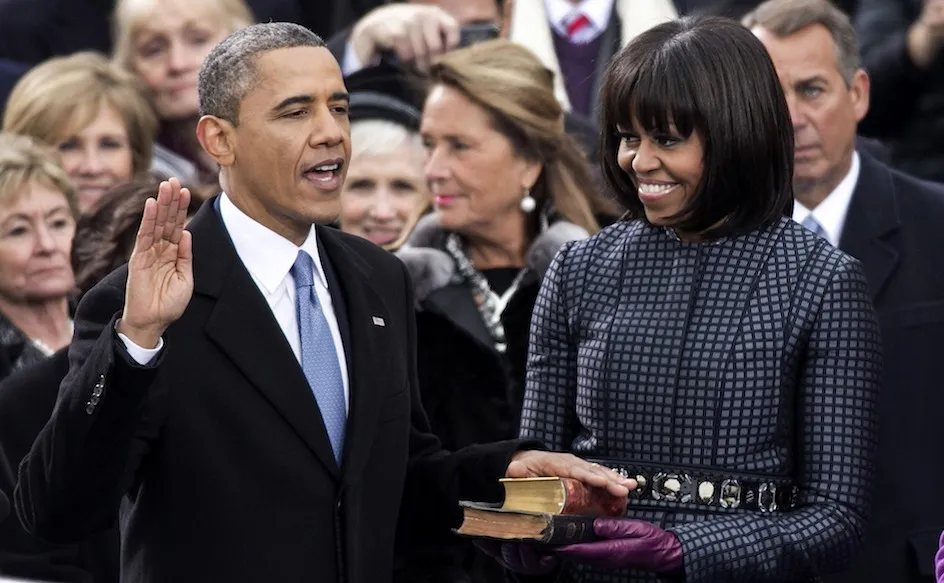
Some 400 People Will Be Interviewed
Starting this summer and over the next five years, the Obama Presidency Oral History Project will conduct interviews with some 400 people, including senior leaders and policy makers within the administration, as well as elected officials, campaign staff, journalists, and other key figures—Republican and Democrat—outside the White House.
The Obama Presidency Oral History Project also will incorporate interviews with individuals representing different dimensions of daily American life, whose perspectives enable the archive to weave recollections of administration officials with the stories and experiences of people who were affected by the Administration’s decisions. This project will also examine Mrs. Obama’s work and legacy as First Lady.
“We are honored to document the legacy of President Obama. Our goal is to set a new benchmark for presidential oral histories in terms of the diversity and breadth of narratives assembled and depth of understanding achieved,” said Mary Marshall Clark, Director of the Columbia Center for Oral History Research and a project co-investigator. “Central to our project is a commitment to candidly document the stories of key administration alumni and bring them into conversation with the varied experiences of Americans from all walks of life.”
Clark will work with Peter Bearman, Jonathan R. Cole Professor of the Social Sciences and Director of the Interdisciplinary Center for Innovative Theory and Empirics, and Kimberly Springer, Curator of Columbia’s Oral History Archives.
“We conduct interdisciplinary research, and a trademark of this project is bringing together experts from across fields of knowledge and expertise to ensure that our interviewers are asking the right questions, whether they are in the offices of policymakers who enacted the Affordable Care Act, or at the kitchen table of citizens whose lives were affected by it,” said Bearman, who will serve as the principal investigator for the project.
Columbia University also announced the formation of the Obama Presidency Oral History Advisory Board, composed of leading presidential historians and authors, including Robert Dallek (GSAS ’57, ’65) and Douglas Brinkley; acclaimed journalists such as Michele Norris and Jelani Cobb, Ira A. Lipman Professor of Journalism at Columbia; and other scholars in history, political science, sociology, and public health, who can speak to how this period affected the lives of those inside and outside of Washington.
The Oral Histories Will Be Publicly Available Online
The oral histories are expected to be publicly available online at Columbia University no later than 2026. Following the project’s completion, the Foundation will look for opportunities to connect the oral history archive with related collections and content, including the National Archives-administered digital records of the Obama presidency.
“Columbia is committed to preserving our past for use in the future,” said Springer, the archives’ curator. “Columbia’s collection is distinguished for the inclusion of perspectives of not just ‘Great Men,’ but the many others who shape our world. Our archive includes a vast array of histories so that current and future generations of historians and citizens can learn lessons from our times.”