About the Conference
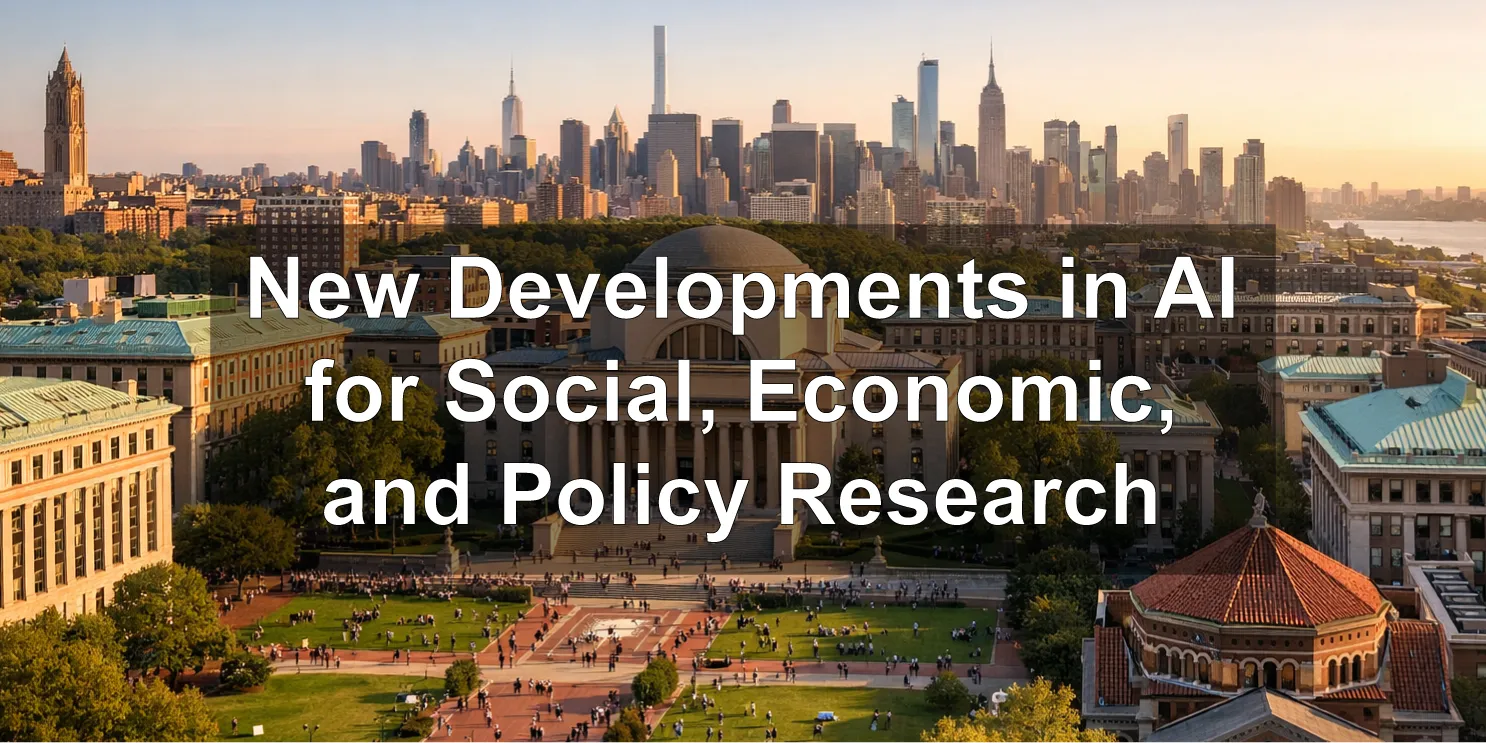
Artificial intelligence is reshaping how work is organized, performed, valued, and governed. These changes extend beyond the adoption of new tools. AI may alter the division of labor between people and machines, transform occupations and professional identities, reorganize workplaces and labor-market practices, and create new opportunities and inequalities.
New Developments in AI for Social, Economic, and Policy Research, centered on the theme AI and the Future of Work, will bring together academic researchers, industry leaders and practitioners, and policymakers to examine these transformations.
The conference welcomes perspectives from sociology, economics, political science, public policy, management, labor studies, computer science, and related fields. It also welcomes insights from organizations developing, implementing, regulating, or responding to AI in the workplace.
Through paper presentations, discussions, and a poster session, the conference aims to foster interdisciplinary exchange, connect research with practice and policy, and advance understanding of how AI is changing work, workers, workplaces, and labor markets.
The conference welcomes academic researchers at all career stages, as well as industry practitioners and policymakers.
Date: Friday, January 29, 2027
Location: Lee C. Bollinger Forum, Columbia University, New York City
Sponsors: Institute for Social and Economic Research and Policy and Columbia Population Research Center
The conference will explore topics including, but not limited to:
Labor Markets and Employment
The effects of AI on hiring, worker evaluation, career mobility, displacement, job creation, and emerging forms of employment.
Occupations Skills and Career Pathways
Changes in occupations, professional identities, skill requirements, expertise, and pathways into and through careers.
AI and Inequality
How AI may reproduce, reduce, or create inequalities by race, gender, class, immigration status, disability, age, and geography.
Human AI Collaboration and the Division of Labor
The augmentation or substitution of human tasks, changing boundaries between human and machine work, and emerging forms of collaboration between workers and AI systems.
Organizations Management and Algorithmic Control
The effects of AI on organizational design, management practices, workplace decision-making, and algorithmic coordination and control.
Job Quality and Worker Well Being
The implications of AI for worker autonomy, workplace surveillance, compensation, working conditions, job security, and well-being.
Worker Voice, Education and Governance
Worker perspectives on AI, unions and collective action, social protection, education and training, and institutional approaches to governing AI at work.
The conference will feature four paper sessions comprising 16 presentations, alongside a dedicated poster session.
The program is designed to encourage substantive discussion and interaction among participants from different disciplinary and methodological backgrounds.
Mario Small
Professor of Sociology, Columbia University
Xi Song
Professor of Sociology, Columbia University
Ziyao Tian
Postdoctoral Research Scholar, Columbia University
Anzhi Chen
PhD Student in Sociology, Columbia University
Jonathan Ben-Menachem
PhD Candidate in Sociology, Columbia University