Five Questions with New Department Chair Adam Reich
(August 2026)
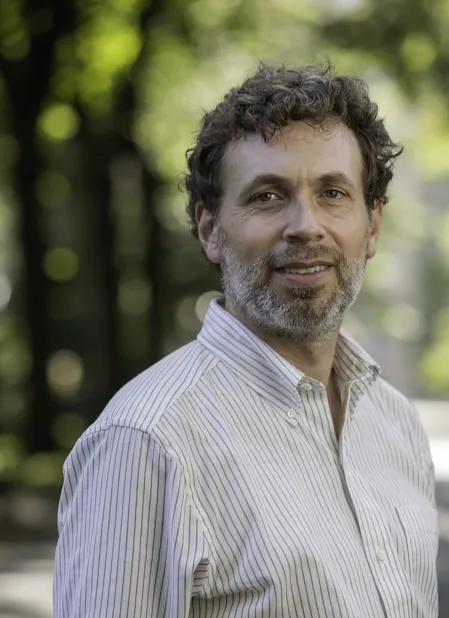
This summer, Professor Adam Reich became the new Chair of the Department of Sociology. To celebrate the transition and to give Adam an opportunity to share his vision for the department, we asked him a few questions about his plans, research, and personal life. Read below for the incoming chair's reflections (including info about his new book!).
Congratulations, Adam!
1. What are some goals that you would like to accomplish as department chair?
I am excited to build on the terrific work of our past chairs, Mario Small and Bruce Western. We have a truly exceptional group of junior faculty members at the moment, and so one of my top priorities is simply making sure that we are supporting them as best we can in their research and teaching. At the same time, some of our most distinguished senior colleagues are retiring in the near future, and so it also feels urgent that we be on the lookout for opportunities to build our senior ranks.
On the department level, I’d like to continue to explore how to make our long, somewhat quiet hallways a bit more lively. For instance, last academic year, Tara Gonsalves led a workshop for faculty and students in which we discussed faculty work in progress, which was a tremendous success. This year, Professor Gonsalves has agreed to supplement such workshops with occasional “salons” in which we’ll discuss – as a community – issues pertaining to our discipline, like the threats and opportunities presented by AI, or the recent criticisms of sociology in the popular press.
At the meso-level, I’d like to continue to support our department’s efforts at building social science research infrastructure at the university. Jennifer Lee has been doing extremely important work here recently with her founding of the Asian American Initiative, and I’m thrilled our department is able to support the Initiative’s work. I’d also like to figure out how to sustain and strengthen our department’s ties with existing research institutes on campus, many of which our faculty lead or founded, such as ISERP, Incite, the Data Science Institute, and Columbia World Projects.
More broadly, I think we are in a moment of crisis and opportunity for the discipline – a crisis distinct from, but related to, broader attacks on higher education: what role does sociology currently play in our society, and what role should it play? Our department – faculty, graduate students, and undergraduates – are uniquely positioned to shape a sociology for the 21st century. And it’s a real privilege to be chair during this time.
2. What do you find to be distinctive about Columbia sociology?
What stands out to me about our department is the wide intellectual range and imagination of our faculty members and students. Many of us do work across multiple subfields of the discipline, often using multiple methodological approaches. It’s pretty infectious.
And while it is a little difficult for me to compare our department with other departments cross-sectionally, I can tell you a story about within-person change over time. I arrived at Columbia in 2012 thinking of myself as a qualitative sociologist. (My dissertation was a qualitative study exploring how different hospital organizations structured workers’ understandings of the relationship between morals and markets.) But the influence of faculty and graduate students at Columbia encouraged me to approach similar theoretical questions (about morals and markets) from a range of different methodological approaches, to get different sorts of purchase on them. My two ongoing projects are largescale experiments that also make use of surveys, in-depth interviews, ethnographic observations, and network analysis.
So one could say that what is distinctive about us is our eclecticism, but there is a bit more order in our chaos. One throughline in our department, since at least Merton, is a focus on the “meso-level” – on the structures (organizations and networks) that mediate between large social facts (the gini coefficient; systems of racial classification) and individual identities, aspirations and decisions. You will see a lot of heterogeneity within and across the research of our faculty and students, but underlying the heterogeneity is this common thread.
3. What research projects are you currently working on?
I just finished a book, Inside Jobs: Prison Work in the American Labor Market, a mixed methods analysis of the changing relationship between the prison and the labor market over the course of U.S. history. This is not what I am currently working on, but it is what I have been working on!
Since 2019, I have served as co-director of the Columbia Labor Lab, an interdisciplinary center on campus. The center works with labor unions and other worker organizations on research projects of mutual interest, in order both to better understand and strengthen these organizations. My two most time-consuming ongoing projects are related to the center.
First, building on some of the findings from Inside Jobs, I’m working (with others, including PhD student Lena Gloeckler and former PhD student Sam Donahue) on a randomized controlled trial about the impacts of union pre-apprenticeship programs for people returning from prison. Studies of transitional job programs have not found particularly promising results, but our hypothesis is that this is because the “transitional jobs” are often of very low quality. The construction industry is one of few industries in which those returning from prison can find work, and a union construction job can be a pathway to a high-paying career. Our study is also unique among studies of this sort in that it combines administrative data with surveys and interviews, meaning we can study a wide range of outcomes and better understand the processes by which these outcomes occur.
Second, I am working (again with others, including several current and former undergraduate students in sociology) on a randomized controlled trial of labor organizing in the nursing home sector. We have partnered with a union in the Midwest who agreed to randomize their organizing targets, meaning that we can test the impact of organizing on workers’ conditions of work and residents’ conditions of care. As far as we know, this is the first time researchers have tried to estimate the effects of labor organizing in this way. The project again combines administrative data, surveys, and more than 1,200 interviews with workers (so far). We started this project in 2021, and are still very much in the middle of it.
If anyone reading this is interested in learning more about the Labor Lab, I’m always happy to talk about it.
4. What do you see as the most exciting developments in sociology right now? And what do you think sociologists should be paying more attention to?
Sociology came into its own as a discipline during the industrial revolution, a period of profound social, economic, and political change. The discipline’s founders were interested not simply in describing the social world, or predicting what would happen next, but also in helping to shape our social institutions so as to harness the possibilities of social change while avoiding its perils.
I don’t think it’s an exaggeration to say that we are living through another period of profound social, economic, and political change. But it is also a period when our expertise as sociologists has perhaps never been more relevant. What effects is AI having on the workplace, and on human sociality? How are societies adapting to the ever-more-evident consequences of climate change? Why are democratic norms eroding, and how might they be restored?
Sociologists today are well situated to address these sorts of questions through rigorous empirical research; research which can in turn provide frameworks of action for those best situated to intervene on them.
5. What is the last book you read?
My summer reading list is very fiction-forward, but I don’t claim to have very good taste in fiction myself – I mostly read what Teresa Sharpe, my partner, tells me to read. A few selections here:
I just finished Flesh, by David Szalay. It is a remarkable book. It reminded me a little bit of Elena Ferrante’s Neapolitan Novels, or at least my experience of reading those novels, in that I felt I had never read anything quite like it. It’s also, at its core, a kind of reflection on masculinity across the life course, as one might say the Ferrante novels are a reflection on femininity across the life course. Highly recommend.
This summer I also discovered Tana French. Why did it take me until the summer of 2026 to discover Tana French? What a great detective novelist! She’s also written lots of books, so I feel like I’ve just discovered a bingeable TV show.
Finally, Pragmatism, by William James. Okay, this one is non-fiction. James is one of my favorite philosophers. I read the book again this summer because I’ve been thinking about how social scientists think about “truth.” Maybe it will help me get things done as chair, too.
Thank you, Adam!
For previous editions of our Five Questions Q&A Series, please click here.